Prefix and Suffix Keyword Research: Modifiers That Reveal Search Intent
One word before or after your seed can change the whole intent of a search. Here's how to choose modifiers and read what Google returns.
A to Z research shows you the breadth of a topic. Prefix and suffix research shows you its intent. By adding a chosen word before or after your seed keyword, you steer Google's predictions toward buyers, comparers, locals or researchers, and see exactly how each group phrases its searches.
Prefix vs suffix
- Prefix: a word before the seed. best mobile car detailing, cheap mobile car detailing.
- Suffix: a word after the seed. mobile car detailing cost, mobile car detailing near me.
Both work the same way in Autocomplete: Google completes the rest of the phrase with real searches that match. The difference is where the modifier naturally sits in the language. English speakers say "best X" and "cheap X", but "X near me" and "X cost". Put each modifier where people actually type it.
Modifier lists by intent
Start with modifiers that match what you want to learn. These are common English modifiers grouped by the intent they usually signal:
| Intent | Prefixes | Suffixes |
|---|---|---|
| Commercial / comparison | best, top, professional, reliable | reviews, vs, alternatives, companies |
| Budget | cheap, affordable, budget, discount | cost, prices, price list, quote, deals |
| Local | local, nearby | near me, in [city], open now, delivery |
| Informational | how to, what is, why, can you | tips, guide, checklist, for beginners, ideas |
| Business owners | start a, starting a | business, equipment, insurance, salary, jobs |
Don't run all of them blindly. Run A to Z first, see which themes appear, and choose modifiers that dig into those themes. If the alphabet pass keeps returning price words, budget modifiers will pay off.
What real prefix and suffix queries return
Here's what seven modifiers returned for mobile car detailing in our case study. All of these are real Google predictions.
"best" (prefix): comparison and reviews
Mostly best + city searches like best mobile car detailing richmond va, plus best mobile car detailing near me reviews. People using "best" are choosing between providers, so reviews and proof matter on these pages.
"affordable" and "cheap" (prefixes): synonyms surface
affordable mobile car detailing returned six predictions that start with cheap, plus affordable mobile auto detailing and affordable mobile car cleaning. Two lessons: Google treats these budget words as close relatives, and prefix queries can reveal alternative names for your topic ("auto detailing", "car cleaning") that belong on the same pages.
"near me" (suffix): local details
Extra words reveal what local searchers care about: within 5 mi, come to my house, open now, book online. Those are service-page requirements written by your customers.
"cost" and "prices" (suffixes): two different audiences
prices stayed with customers: prices near me, prices list, and country variants like prices uk and prices australia. cost split in two: half its predictions were about running a business: startup cost, setup cost, insurance cost. Two near-synonyms, two very different audiences.
"services" (suffix): related phrasings
Besides services near me and services price list, Google returned mobile car cleaning services and mobile auto detailing services, more alternative phrasings to cover.
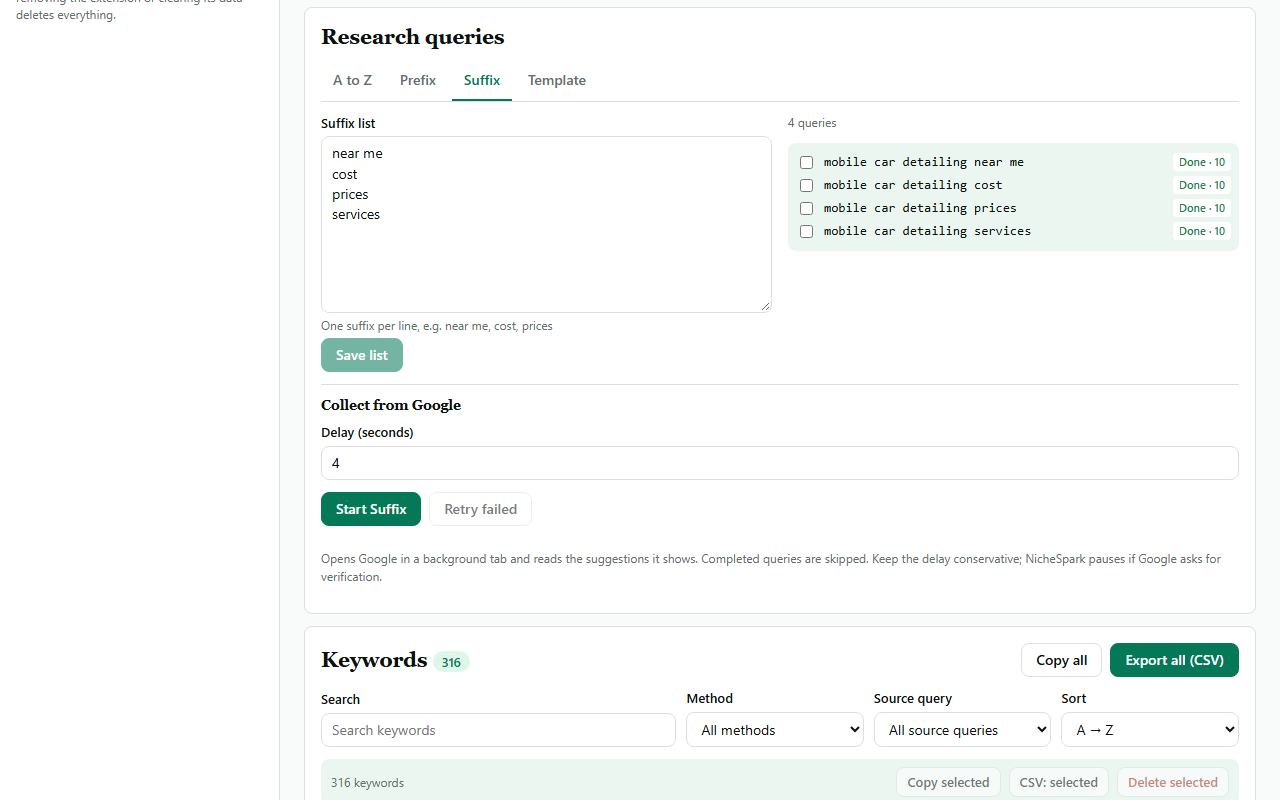
How to run prefix and suffix research
- Start from your A to Z results. List the recurring themes.
- Choose 3 to 10 modifiers that match those themes and your goals. Put each in its natural position.
- Run one modifier per query, waiting for the dropdown to settle before recording.
- Record the source query for every prediction. It explains why a keyword appeared.
- Merge duplicates and look for overlaps. A keyword returned by both a letter and a modifier, like mobile car detailing prices list from p and from prices, marks a strong theme.
In NicheSpark you keep your prefix and suffix lists per project, preview the exact queries before starting, and run all of them or just the ones you select. Completed queries are skipped next time, and failed ones can be retried.
Turning modifiers into pages
Each intent group maps naturally to a page type:
- Budget and price modifiers → a pricing page or cost guide.
- "best" and "reviews" → comparison content or a service page with strong proof.
- "near me" and city modifiers → service and location pages for areas you actually serve.
- Business-owner modifiers → a separate section or site for people starting out.
Keep one page per group to avoid keyword cannibalization. cost, prices and price list from customers belong together; business startup costs belong elsewhere.
Frequently asked questions
How many modifiers should I use?
Start with 3 to 10 chosen from your A to Z themes. More is not better if they don't match your goals; it just adds noise to sort through.
Can I combine a prefix and a suffix?
Yes, for example cheap mobile car detailing near me. Use combinations to explore a strong theme further, but expect fewer predictions as the query gets more specific.
Do modifiers work in other languages?
Yes, but use the modifiers native speakers actually type, in their natural position. Word order differs between languages.
What if a modifier returns nothing useful?
That's useful too: it suggests low demand for that angle, or that Google phrases it differently. Try a synonym, and don't force content where searchers aren't asking.
New to autocomplete research? Start with the complete guide and the A to Z method.